About us
High in the North Wessex Downs overlooking the Vale of the White Horse, and nestled in the shadow of the historic Ridgeway, lays the village of Chilton. Surrounded by an area of outstanding natural beauty, the chalk downland is rich in features dating back to pre-historic times. Nearby Churn is believed to have been the place where, in the early 7th century, St Birinus converted the people of Wessex to Christianity.
The origin of the name “Chilton” is not known. In Old English, it literally means “Children’s tun, or farm”, although to what this might have referred is unclear. It first appears in written form in 891 as “Cyldatun”. As centuries passed, the name has altered to “Cildatun” (1015), “Cilletone” (1086), “Childestuna” (12th century), “Chiltune” (13th century) and “Chylton” (1556). The close proximity to the Ridgeway led to it being known as “Chylton Egg” (pronounced “edge”) from 1397 to 1450 and, in the 19th century, “Chilton-in-the-Vale”. In the 14th century, it was also known as “Chilton Danvers”, after the name of the family that owned the manor.
In the sparsely populated Downs, the local economy was for centuries dominated by agriculture. Chilton was also associated with the world of horse racing for many years, with several racing stables being located in the village, although no stables remain today.
The advent of nuclear energy in the years following the Second World War spawned the nearby Atomic Energy Research Establishment (now the Harwell International Business Centre) and the Rutherford Appleton Laboratory, which were built on the former airfield RAF Harwell.
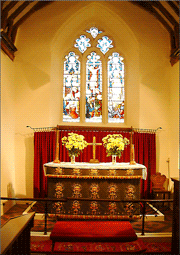
All Saints' Chilton has a 12th century nave with a 13th century south aisle and a 14th century chancel. There is also a two-floor extension. The stone tower is Victorian. The bells which have been silent for many years due to structural problems have been restored. The bells and the recently restored clock were formally rededicated in January 2001.